Higher and partial derivatives: choose the right variable
The number 12 can be a tangent slope, a second derivative or a partial derivative at a point. Its meaning depends on which variable you changed and how many times you differentiated. I write those two choices beside the original function before comparing any numerical answer.
How do I choose the variable and derivative order?
A first derivative measures the instantaneous rate of change with respect to one variable. A second derivative differentiates that rate again. A third derivative continues the process; the fourth and fifth do the same. Changing the order is therefore a new mathematical question, not a display setting for the first derivative.
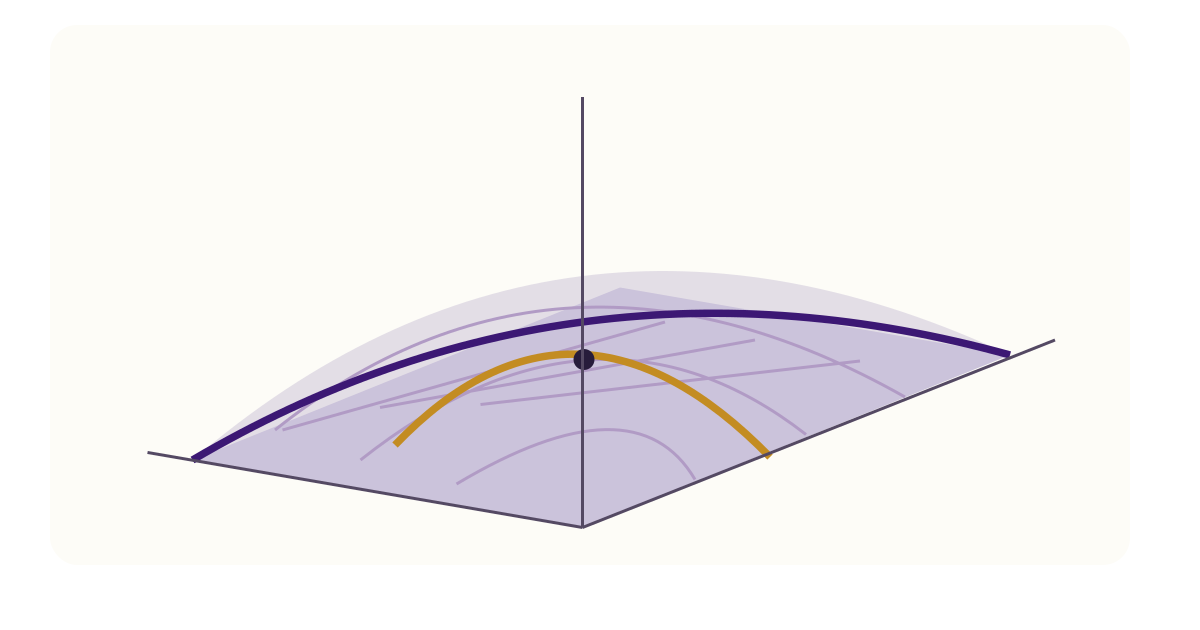
For a function of several independent variables, a partial derivative changes one variable while holding the others fixed. Differentiating with respect to y does not mean setting x to zero, and selecting order two does not request a mixed derivative with respect to x and then y. The calculator repeats differentiation with respect to the same selected variable.
In the derivative calculator, choose x, y, t or z and an order from one to five. Enter only an explicit expression, such as x^2*y. Equations such as x^2+y^2=1 need implicit differentiation and are not supported here. There is no assumption that y secretly depends on x; symbols other than the selected variable are treated as constants.
How do I calculate the first five derivatives of a polynomial?
Take f(x) = x^5−2*x^3+7. The first derivative is 5*x^4−6*x^2: the exponent multiplies the coefficient and then decreases by one. The constant 7 contributes zero. Differentiating again gives 20*x^3−12*x, then 60*x^2−12, then 120*x, and finally 120.
At a = −1.25, the original value is (−1.25)^5−2*(−1.25)^3+7 = −3.0517578125+3.90625+7 = 7.8544921875. Keep that value separate from every derivative value. It locates a point on the function, while the derivative cards describe different rates at that point.
| Order | Derivative expression | Value at −1.25 |
|---|---|---|
| 1 | 5*x^4−6*x^2 | 2.83203125 |
| 2 | 20*x^3−12*x | −24.0625 |
| 3 | 60*x^2−12 | 81.75 |
| 4 | 120*x | −150 |
| 5 | 120 | 120 |
I check the second-order row explicitly: 20*(−1.953125)−12*(−1.25) = −39.0625+15 = −24.0625. A positive first derivative and a negative second derivative can coexist. Here the function is increasing locally while its slope is decreasing. The second derivative is not a negative tangent slope.
For a polynomial of degree five, the fifth derivative is constant and the sixth is zero. The tool stops at order five, so it does not expose that sixth-order calculation. A degree-three polynomial already has a zero fourth derivative. Higher order is not automatically more informative; choose it to answer a particular question.
Which derivative gives the tangent slope?
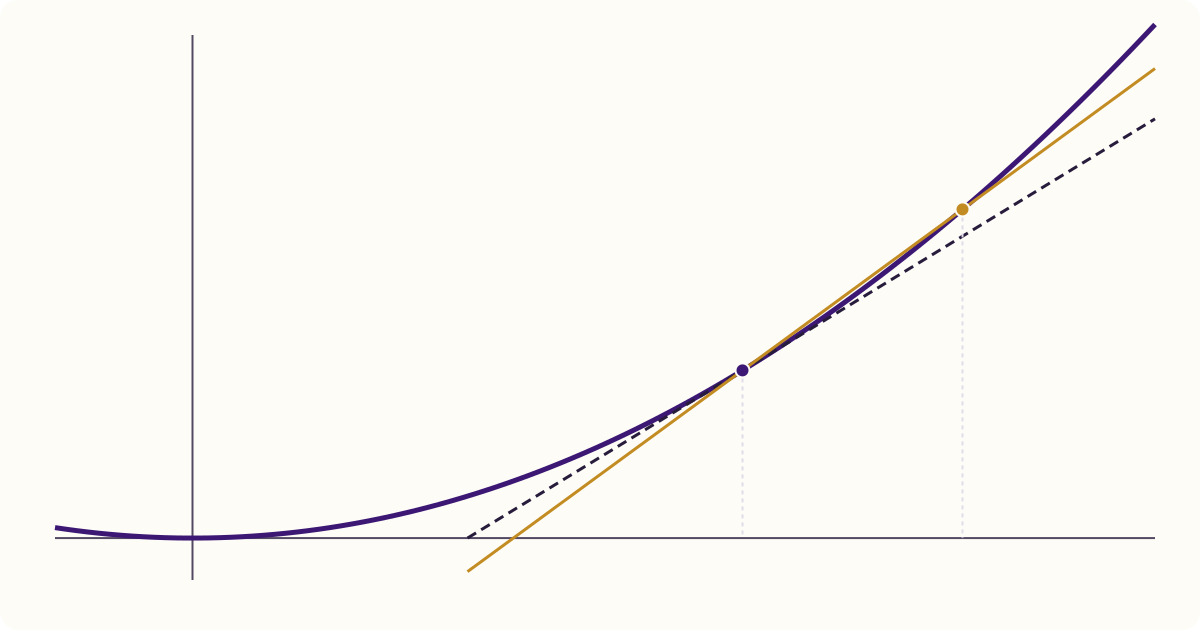
For that polynomial at a = −1.25, the tangent is y = 7.8544921875 + 2.83203125*(x+1.25). Selecting order two leaves this line unchanged. The selected derivative card becomes −24.0625 and the dashed violet curve becomes the second derivative, but the tangent still touches the original function and uses its first derivative.
This distinction matters when examining concavity. A second derivative that is positive on an interval indicates an increasing first derivative there; a negative second derivative indicates a decreasing one. A zero second derivative at one point does not by itself prove an inflection point. Check its sign on either side and the original function's continuity before describing a change in concavity.
The forward secant and centered numerical slope in this tool also refer to the original function. They estimate its first derivative, not the currently selected higher derivative. I use them to check a tangent calculation. For the full discussion of interval size, floating-point subtraction and cusps, read Tangents, secants and real-domain restrictions.
How do I evaluate a partial derivative with parameters?
Consider F(x,y) = x^3*y+sin(y). The partial derivative with respect to x is 3*x^2*y because y and sin(y) are constant with respect to x. At x = 1.7 with y = 0.4, its value is 3*2.89*0.4 = 3.468. Select x, enter the point 1.7 and assign y=0.4 in Other variable values.
With respect to y, the answer changes to x^3+cos(y). At y = 0.4 with x = 1.7, the value is 4.913+0.9210609940 ≈ 5.8340609940. Select y, enter the point 0.4 and assign x=1.7. Those are two different rates at the same pair of input values; neither replaces the other.
The second partial derivative with respect to y is −sin(y), which is approximately −0.3894183423 at 0.4 radians. The second partial derivative with respect to x is 6*x*y, giving 6*1.7*0.4 = 4.08. A mixed partial derivative would instead differentiate 3*x^2*y with respect to y and give 3*x^2. This tool does not calculate mixed orders in one run.
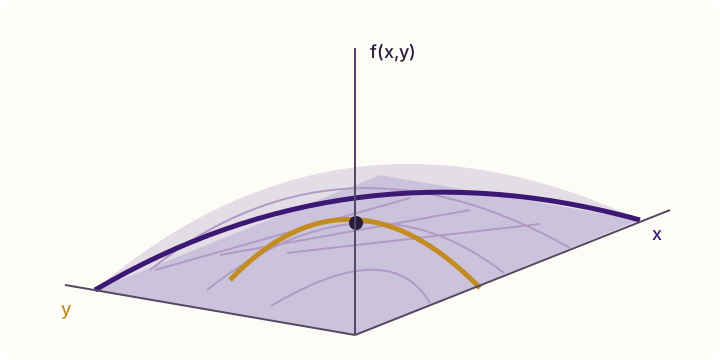
Parameter assignments use semicolons: x=1.7; z=3. The chosen differentiation variable cannot be assigned there. The point field supplies its value. If you switch from x to y, remove the old y assignment and supply x instead. A missing or conflicting assignment produces an error rather than a guessed graph.
Where are higher derivatives defined?
Differentiation does not expand the original real domain. For ln(x), the successive derivatives are 1/x, −1/x^2, 2/x^3, −6/x^4 and 24/x^5, all on x > 0. Although several of those formulas can be evaluated at negative numbers, they are not derivatives of the original real logarithm there.
At x = 2, these five values are 0.5, −0.25, 0.25, −0.375 and 0.75. The fifth value follows from 24/2^5 = 24/32. I compare a higher-order result at a point inside the domain before trusting its apparent pattern. Repeated chain and quotient rules can produce a long formula whose signs are difficult to judge at a glance.
The engine checks the original expression and preceding derivative stages. For sqrt(x^4), the real identity x^2 is applied before differentiation, giving first derivative 0 and second derivative 2 at zero. The steps name this identity. Other removable formula exceptions can still be unavailable; resolve those using limits or justified algebra rather than treating an unavailable label as a proof. The chain-rule guide explains why real branches and grouping matter.
The standard composition, power and logarithm rules are explained in OpenStax's chain-rule section and its exponential and logarithmic derivatives section. The worked values above follow by applying those rules repeatedly.
What should I check before saving a derivative?
- Keep the original expression and inspect its parentheses.
- Name the variable you are changing and the variables held constant.
- Choose an order that answers your question.
- Supply the evaluation point and each required parameter value.
- Distinguish the selected-order value from the first-derivative tangent slope.
- Check the original domain before exporting or saving the calculation.
Saving preserves the variable, order, point, interval, parameters and graph bounds together with the expression. History stays in the current tab unless you enable device storage. I keep that complete setup rather than copying a bare number: without the variable and order, even a correct derivative value can answer the wrong question.
Quick answers
Does order two calculate a mixed partial derivative?
No. The calculator differentiates twice with respect to the same selected variable. Other symbols are held constant.
Why does the tangent stay the same when I change the order?
The tangent uses the first derivative of the original function. The selected higher derivative has its own value and curve.
Can I differentiate an implicit equation here?
No. Enter an explicit expression. Equations containing an equals sign and implicit differentiation are not supported.